Timing Your ISO Exercises Around the AMT: Why Paying Tax on Money You Never Received Is Avoidable Pain
Short answer: When you exercise incentive stock options (ISOs) and hold the shares, you owe no regular income tax that year, but the "bargain element" (the gap between your exercise price and the stock's value) counts as income for the alternative minimum tax, or AMT. That can create a real tax bill on paper profit you have not received in cash. Because the AMT only bites above a certain line each year, how much you exercise and when you exercise often matter more than whether you exercise at all.
What makes ISOs different from other stock compensation?
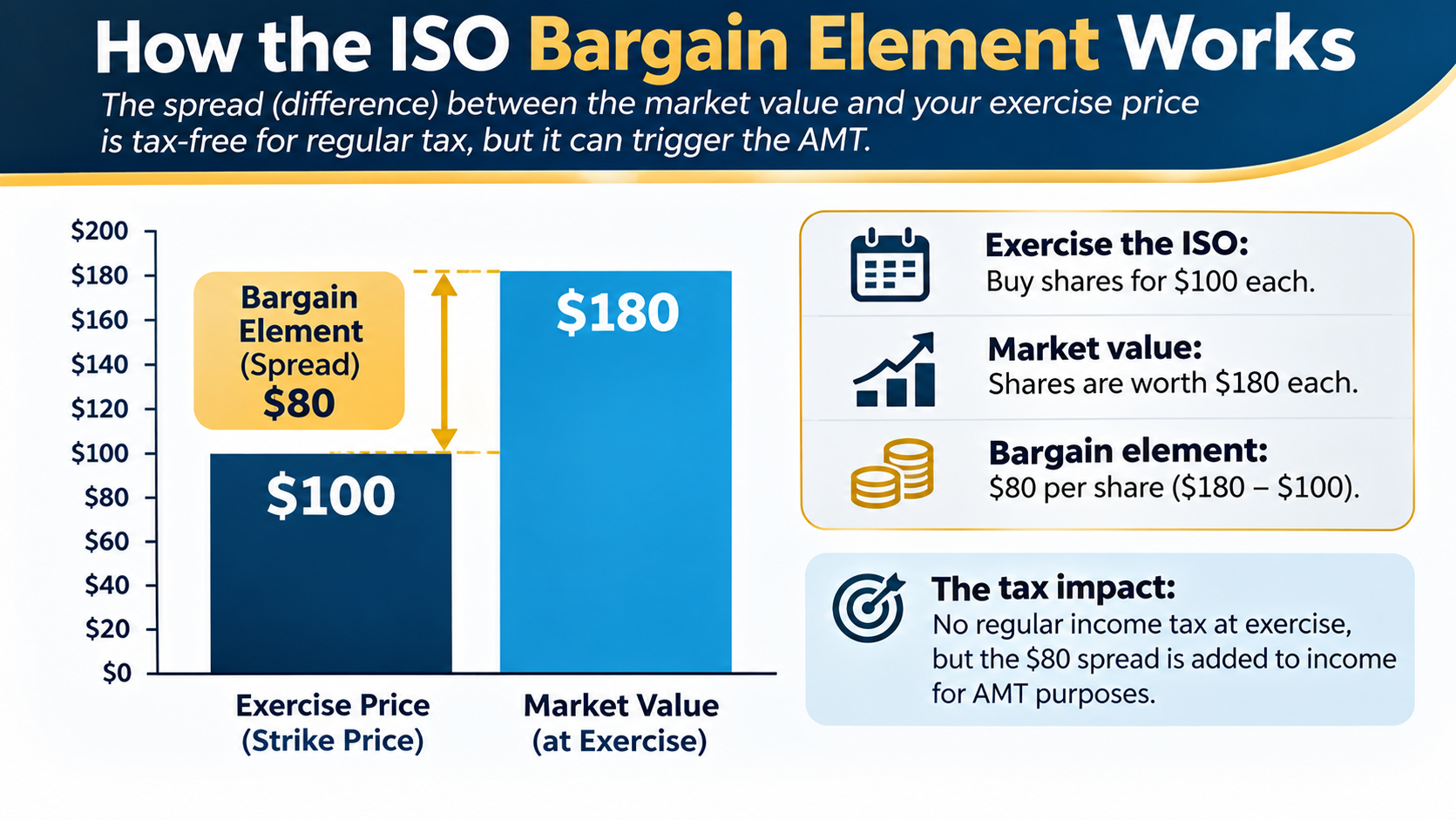
An incentive stock option is the right to buy your company's stock at a fixed price, called the strike or exercise price, for a set period of time. If the stock rises above that price, you can buy shares for less than they are worth. That difference, the stock's fair market value on the day you exercise minus your strike price, is called the spread or the bargain element.
ISOs get special treatment in the tax code that non-qualified stock options and RSUs do not. According toIRS Topic 427, you generally do not include anything in income for regular tax purposes when an ISO is granted or when you exercise it. If you then hold the shares long enough, the whole gain can be taxed at long-term capital gains rates when you sell. The holding rules are specific: the sale has to happen more than two years after the option was granted and more than one year after you exercised.Schwab's guide to ISO taxescalls a sale that meets both tests a qualifying disposition. A sale that misses either one is a disqualifying disposition, and the spread at exercise is then taxed as ordinary income, like wages.
That is the prize ISOs dangle in front of you: the chance to turn what would otherwise be compensation into capital gain. The AMT is the toll booth on the way there. For the Austin-area tech professionals we work with, ISOs are often the single largest tax decision of the year.
Why does exercising ISOs trigger the alternative minimum tax?
The alternative minimum tax is a second, parallel tax calculation that runs alongside your regular return. You calculate your tax the normal way, then calculate it again under the AMT rules, which add back certain items and allow fewer deductions. You pay whichever number is higher. The extra amount, if any, is your AMT, reported onForm 6251.
One item the AMT adds back is the ISO bargain element when you exercise and hold the shares past the end of the year. Schwab puts it plainly: the spread is added back to your income on Form 6251 in the year of exercise. So for regular tax purposes nothing happened, but for AMT purposes you just received income equal to the spread. You did not get a paycheck. You did not sell anything. You may have even spent cash to buy the shares. And you can still owe tax.
As I tell my clients, ISOs let you choose when you are taxed. The AMT is what you pay when you choose to ignore it.
Where is the AMT line for 2026?
For 2026, the AMT exemption is $140,200 for married couples filing jointly and $90,100 for single filers, according to theJournal of Accountancy's summary of the IRS inflation adjustments. The exemption begins to phase out at $1,000,000 of alternative minimum taxable income for joint filers and $500,000 for single filers, shrinking by 50 cents for every dollar above those lines. Above the exemption, the AMT rate is 26%, rising to 28% on amounts over $244,500, per theTax Foundation.
Here is the key idea. Most high earners don't pay AMT in a normal year because their regular tax is already higher than the AMT calculation. The distance between those two numbers is your AMT room: the amount of ISO spread you can absorb in a given year before the AMT starts. Exercise within that room, and the AMT may never show up. Blow past it in one year, and every extra dollar of spread is taxed at 26% or 28% under the AMT.
How much does timing actually change the bill? A worked example
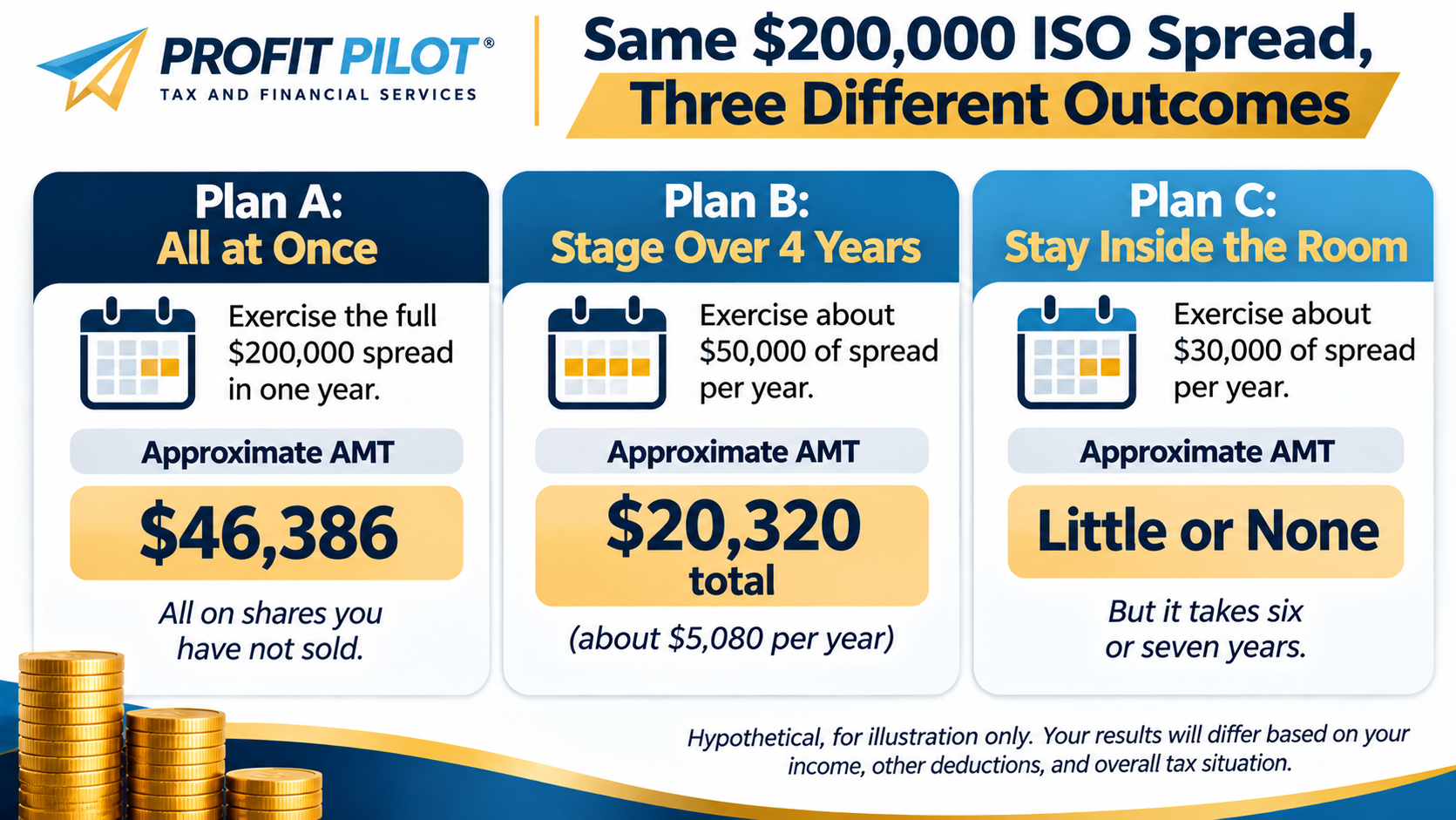
Hypothetical, for illustration only.Victoria and her spouse file jointly and live in Texas, so there is no state income tax. Victoria's salary is $300,000, they take the 2026 standard deduction of $32,200, and they have no other income. She holds vested ISOs with a total spread of $200,000 today. We will assume the stock price and her salary stay flat, ignore payroll taxes, and look only at federal income tax. In a normal year her regular tax (about $49,468) already exceeds her AMT calculation (about $41,548), so she owes no AMT and has roughly $30,000 of AMT room before any applies.
Here is how the same $200,000 of spread plays out on three different schedules:
Every figure is hypothetical and simplified. Your numbers will differ, and a real projection should include your state, deductions, other equity income, and the stock's actual price path. The shape of the lesson is what matters: the same options, exercised on a different schedule, produced AMT bills ranging from roughly zero to about $46,000. This is the kind of modeling we do for clients through ourexecutive and high-earner tax services.
Do you ever get that AMT back?
Often, at least in part. AMT caused by ISOs is generally a timing difference, not a permanent one, so it can create a minimum tax credit that you claim on Form 8801 in later years. Schwab notes the credit may reduce your regular tax in years when your regular tax exceeds your AMT calculation. When you eventually sell the shares, your basis for AMT purposes includes the spread you already paid tax on, which helps avoid paying twice.
The catch is pace. In our hypothetical, Victoria's normal-year gap between regular tax and the AMT calculation is about $7,920, which roughly limits how much credit she can recover in a year like that. Recovering $46,000 could take many years. That is money tied up with the IRS, and if the stock falls after exercise, she may have paid AMT on a gain that later shrank or disappeared. That's how people end up owing tax on stock that is worth less than the tax.
What are the biggest mistakes people make with ISOs and the AMT?
The first mistake is exercising late in December, or all at once, without running the numbers.Kitces has written about why ISO decisions belong in a financial plan rather than in a year-end rush. Exercising earlier in the year gives you something valuable: time. If the stock drops sharply after an early-year exercise, selling the shares in the same calendar year turns the exercise into a disqualifying disposition, which generally removes the AMT add-back and can limit the ordinary income to your actual gain. That option disappears once the calendar turns.
The second mistake is forgetting the holding period clock. Selling one week too early can convert a long-term capital gain into ordinary income on the entire spread. In our hypothetical, if Victoria sold all $200,000 of spread in a disqualifying disposition, it would add about $53,140 of regular tax. If she met both holding periods instead, that same $200,000 taxed at a hypothetical 15% long-term rate plus the 3.8% net investment income tax would be about $37,600. Holding, however, is not free. It means more of your wealth riding on one company's stock, and that tradeoff deserves an honest conversation with an advisor who sees your whole picture. Nothing here is a recommendation to buy, sell, or hold any security.
The third mistake is missing the paperwork. Your employer should send Form 3921 for each ISO exercise, showing the dates, strike price, and fair market value you need for both your AMT calculation and your later basis. Keep every one of them.
Key takeaways
- Exercising ISOs and holding the shares generally creates no regular income tax, but the bargain element is added to income for the alternative minimum tax.
- For 2026, the AMT exemption is $140,200 for joint filers and $90,100 for single filers, phasing out above $1,000,000 and $500,000 respectively.
- Most high earners have some AMT room each year; exercising within it can reduce or defer AMT, while exercising all at once can create a large bill on unsold shares.
- AMT from ISOs can often be recovered later through the minimum tax credit on Form 8801, but recovery can be slow.
- A qualifying disposition requires holding more than two years from grant and more than one year from exercise.
- Exercising early in the year preserves the option to sell in the same year if the stock falls.
- All figures here are hypothetical, and the right schedule depends on your situation.
Frequently asked questions
Do I owe regular income tax when I exercise ISOs?Generally no, as long as you hold the shares. The bargain element is not regular income at exercise, but it is added to income for the AMT calculation in that year.
What is the bargain element?It is the stock's fair market value on the day you exercise minus your strike price, multiplied by the number of shares. Your Form 3921 shows the figures you need.
What is the AMT exemption for 2026?It is $140,200 for married couples filing jointly and $90,100 for single filers, and it phases out above $1,000,000 of alternative minimum taxable income for joint filers and $500,000 for single filers.
What is a disqualifying disposition?A sale of ISO shares within two years of the grant date or within one year of exercise. The spread at exercise is then taxed as ordinary income instead of long-term capital gain.
If I pay AMT on my ISOs, is that money gone?Not necessarily. AMT from ISOs can generate a minimum tax credit, claimed on Form 8801, that may reduce your regular tax in future years. How quickly you recover it depends on your future income and tax picture.
Can I owe AMT on ISO shares that later lose value?Yes, and this is the hard part. The AMT is calculated on the spread at the moment you exercise. If the stock falls afterward and you keep holding, you can owe tax on a gain that has since shrunk or disappeared. Selling the stock in the same calendar year it drops can avoid that outcome by turning it into a disqualifying disposition.
How do I know how much I can exercise without triggering AMT?It depends on your income, deductions, and state taxes for the year. A tax professional can run a projection comparing your regular tax and AMT to estimate how much you can exercise before triggering AMT. If you want that modeled for your situation, you canstart a conversation with our team.
Does Texas have its own AMT?No. Texas has no state income tax, so there is no Texas AMT. Everything in this article is federal, which is one less moving part for Austin and Cedar Park employees than for those in high-tax states.
Does it matter what time of year I exercise?It can. Exercising earlier in the year gives you time to decide whether to hold the shares or sell them that same year, which changes how the exercise is taxed.
What happens to my ISOs when I leave the company?Most plans give you a short window, often 90 days, to exercise vested options after you leave, and unexercised options usually expire. Leaving can also force a timing decision you did not plan for, which is exactly when the AMT math matters most. Check your specific plan documents.
How are ISOs different from non-qualified stock options (NSOs)?With NSOs, the spread is taxed as ordinary income at exercise, with no AMT interaction and no special holding-period benefit. ISOs avoid ordinary income at exercise but include the spread in the AMT calculation, and they offer long-term capital gains treatment if you meet both holding periods.
About Jeff
Jeff Kikel, ChFC, CRPC, ATA,has spent more than 30 years helping people keep more of what they earn, including more than 15 years working with business owners on the biggest financial decision most will ever make: how to sell. He foundedProfit Pilot Tax and Financial Servicesin Cedar Park, Texas, where he helps business owners and high earners stop overpaying taxes by planning ahead instead of just filing. He is the author of more than 20 books and the host of the Cents of Things and Exit Rich...Retire Free podcasts. His designations include Chartered Financial Consultant (ChFC), Chartered Retirement Planning Counselor (CRPC), and Accredited Tax Advisor (ATA).
Get the full guide
Timing your ISO exercises around the AMT is one of the moves in my free guide,10 Tax Moves High Earners Miss. It covers this move plus nine more, from your ESPP holding rules to Roth conversions, written in plain English for busy professionals who would rather plan ahead than be surprised in April.Download your free copy here.
This article is for general educational purposes only and is not tax, legal, accounting, or investment advice. Nothing here is a recommendation to buy, sell, or hold any security. Every situation is different, and the rules and dollar limits referenced here can change. Please consult a qualified tax professional before acting. Any examples are hypothetical and do not guarantee any result.
Sources
- IRS: Topic no. 427, Stock options
- IRS: Publication 525, Taxable and Nontaxable Income
- IRS: Form 6251, Alternative Minimum Tax, Individuals
- IRS: Revenue Procedure 2025-32 (2026 inflation adjustments)
- Journal of Accountancy: Annual inflation adjustments announced for tax year 2026
- Tax Foundation: 2026 Tax Brackets and Federal Income Tax Rates
- Charles Schwab: Incentive Stock Option (ISO) Taxes: A Guide
- Kitces: 3 Strategies To Optimize Incentive Stock Options (ISOs)
Recent Posts