
The RSU Withholding Gap: Why Your Vesting Shares Can Turn Into an April Tax Bill
Short answer:When restricted stock units vest, most employers withhold federal income tax at a flat 22% supplemental rate, but many high earners are actually taxed at 32%, 35%, or 37% on that income. The difference does not disappear; it shows up as a balance due in April, sometimes with a penalty attached. A second trap waits when you sell: if the cost basis on your brokerage form is reported as zero or too low, you can end up paying tax on the same income twice unless you correct it.
What actually happens, tax-wise, when RSUs vest?
A restricted stock unit, or RSU, is a promise from your employer to give you shares of company stock once you meet certain conditions, usually staying employed through a vesting date. Nothing is taxable when the RSUs are granted. The tax event is the vest. On that day, the fair market value of the shares you receive is treated as ordinary income, the same as salary, and it shows up on your W-2.Schwab's guide to restrictedstock describes it plainly: RSU income is taxed like wages when the shares are delivered to you.
That part surprises almost nobody. What surprises people is what comes next. Because the shares are compensation, your employer has to withhold tax, and it usually does that by selling some of the shares on your behalf (often called "sell to cover") or by holding back shares. The question is how much it withholds, and that is where the gap begins. For the Austin-area tech professionals we work with, this is one of the most common April surprises we see.
Why do employers withhold only 22% on RSU income?
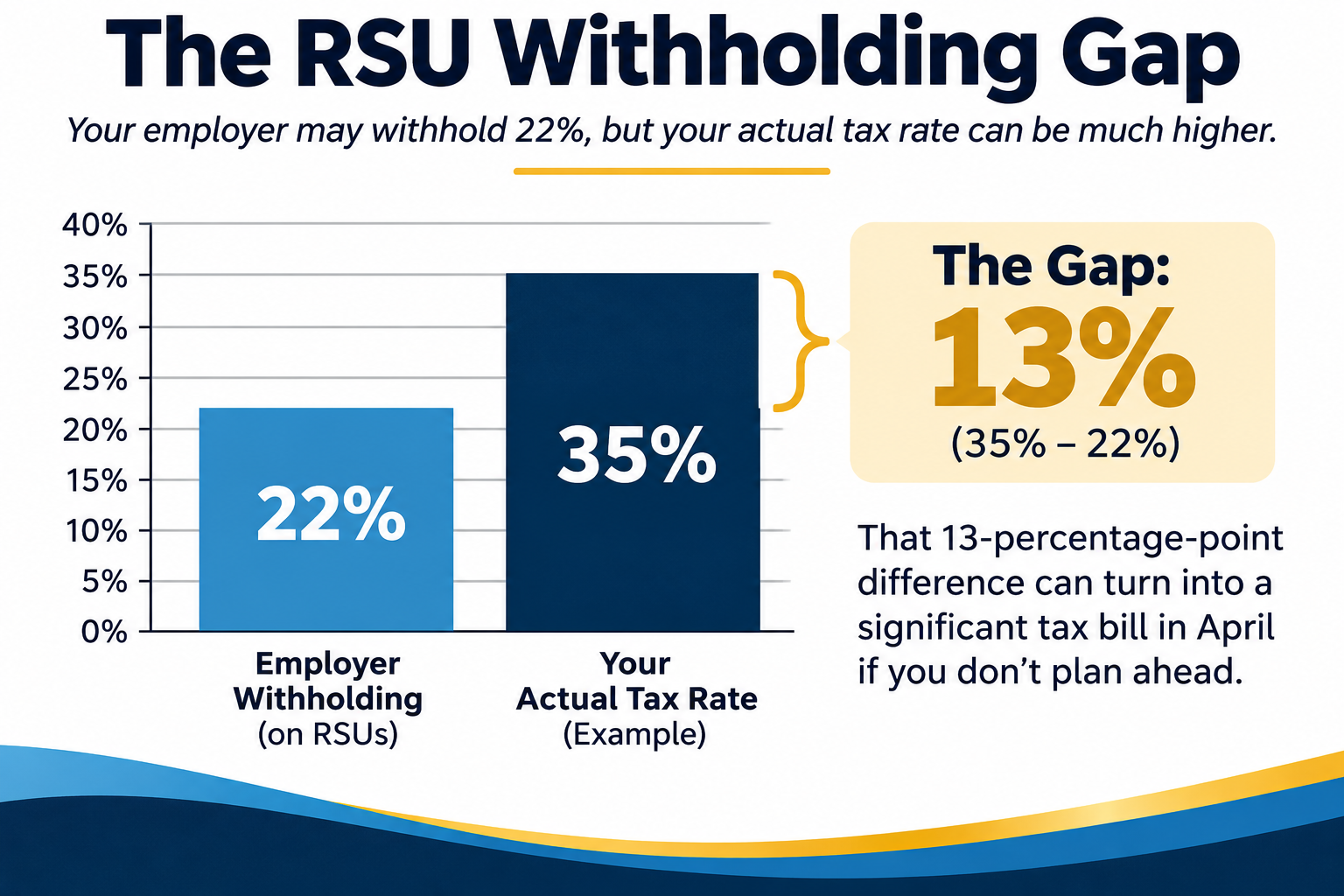
The IRS treats RSU income as "supplemental wages," which is the category for pay outside your regular paycheck, such as bonuses, commissions, and equity compensation. For supplemental wages,IRS Publication 15allows employers to withhold federal income tax at a flat 22%. Once an employee's supplemental wages pass $1 million in a calendar year, the rate on the excess becomes a mandatory 37%. Most executives never cross that $1 million line in a single year, so their RSU income is taxed at the flat 22%.
Here is the problem. That 22% rate is a withholding convenience, not a measure of what you actually owe. Your actual tax is set by your marginal bracket, which is the rate on your last dollars of income. For 2026, according to the TaxFoundation's summary of IRS figures, a married couple filing jointly moves into the 32% bracket above $403,550 of taxable income, into 35% above $512,450, and into 37% above $768,700. If your salary already fills the lower brackets, every dollar of vested RSU income lands on top of it, often at 32% or 35%. Withholding 22% on income taxed at 35% leaves 13 cents of every dollar unpaid.
As I tell my clients, your salary is usually withheld about right. It is the stock that quietly runs up the bill.
How big can the gap get? A worked example
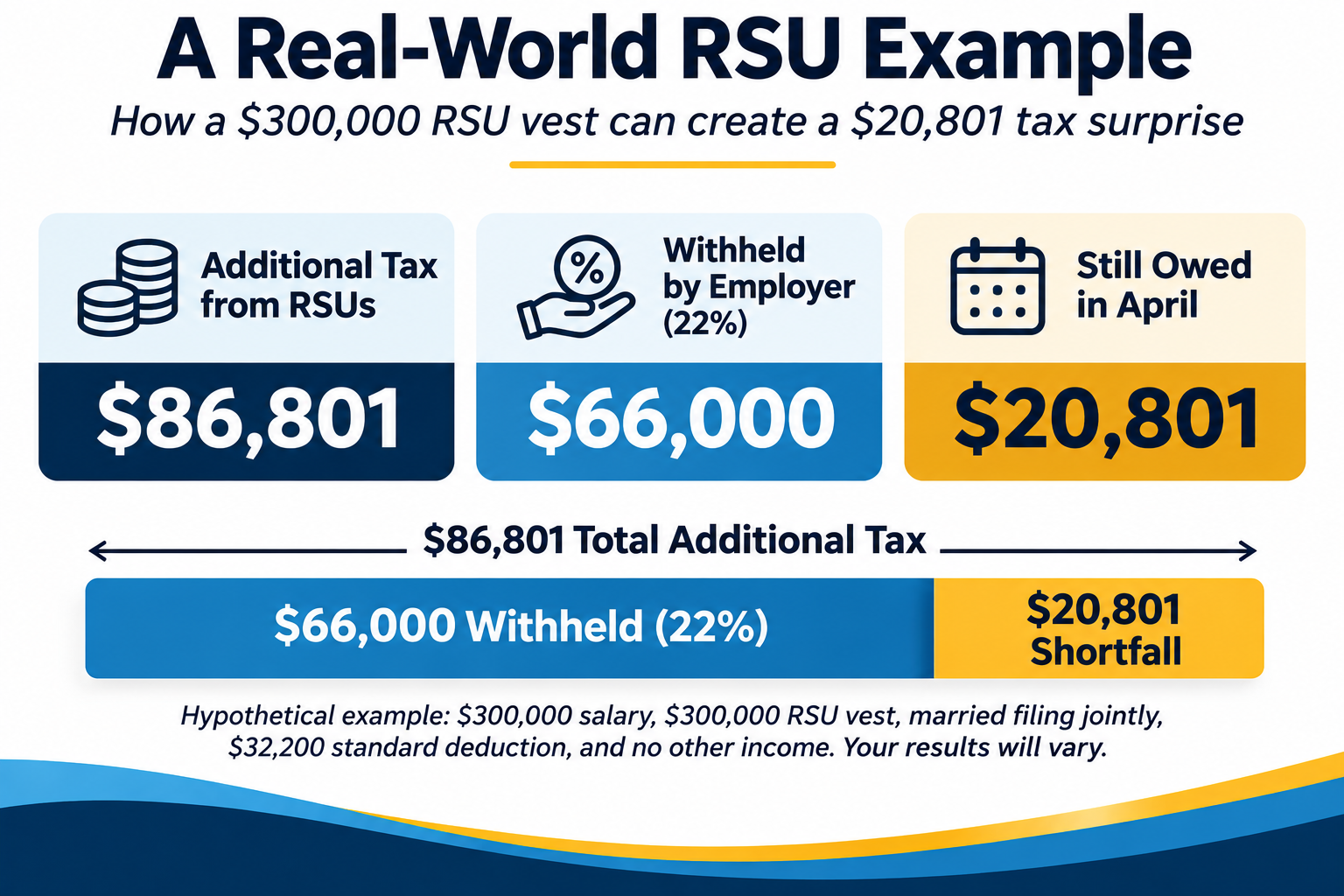
Hypothetical, for illustration only.Victoria and her spouse file jointly. Victoria earns a $300,000 salary, and her spouse has no earned income. In 2026, $300,000 of her RSUs vest. They take the 2026 standard deduction of $32,200 and have no other income. They live in Texas, so there is no state income tax in this example, and we will set Social Security and Medicare aside to focus on federal income tax.
- Taxable income from salary alone: $300,000 minus $32,200, or $267,800. Federal income tax on that amount is about $49,468, and her regular paycheck withholding roughly covers it.
- Taxable income with the RSUs: $567,800. Federal income tax rises to about $136,269.
- Tax actually caused by the RSUs: about $86,801, an average of roughly 28.9% on that income, because it spans the 24%, 32%, and 35% brackets.
- Withheld on the RSUs at 22%: $66,000.
- Gap: about $20,801 that is still owed when they file.
Every figure here is hypothetical and simplified, and your numbers will differ. The point is the shape of the problem. Nobody did anything wrong, the employer followed the rules, and the couple still ends up with a five-figure surprise. This is the kind of modeling we do for clients through our executiveand high-earner tax services.
Can you get penalized for the shortfall, not just billed?
Yes, and this is the part people miss. The IRS expects tax to be paid throughout the year, either through withholding or estimated payments. Its page on theunderpayment penaltyexplains that you generally avoid the penalty if you owe less than $1,000 at filing, or if you paid at least 90% of this year's tax or 100% of last year's tax, whichever is smaller. If your adjusted gross income last year was over $150,000, that prior-year figure becomes 110%.
That 110% safe harbor is worth understanding, because it is often the cleanest way to manage a big vesting year. If you know what you paid last year, you know the target that protects you from the penalty, even if you still owe a balance in April. There is also a useful timing detail in theinstructions for Form 2210:withholding is generally treated as if it were paid evenly across the year, unless you choose otherwise. That means extra withholding added late in the year can count as if it had been paid all along, which is something estimated payments made late do not do. Whether that helps you depends on your own situation, so this is a conversation to have with your tax professional before the year closes.
What is the cost basis double-tax trap?
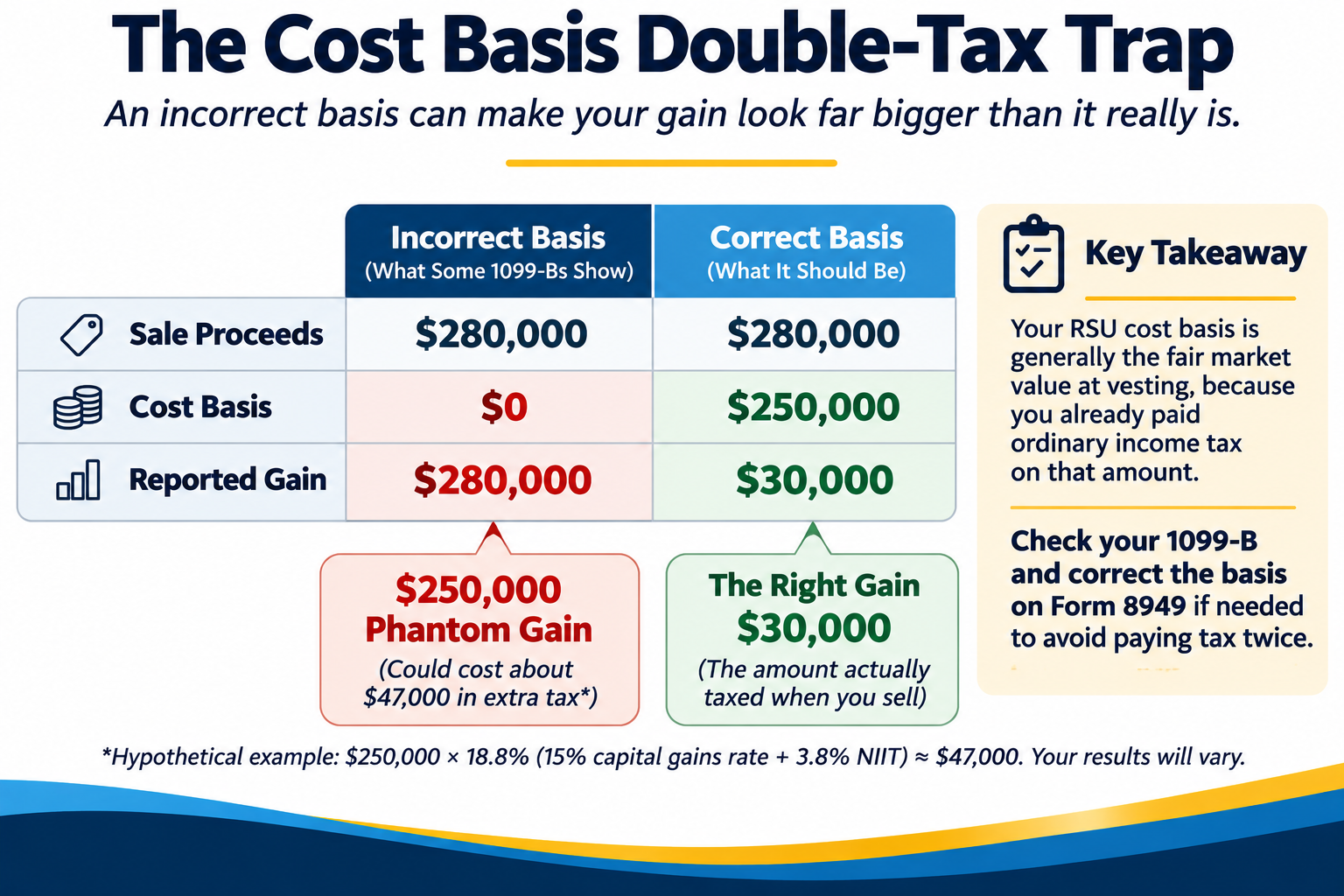
The second trap shows up later, when you sell the shares. Your cost basis is the amount you are treated as having already paid for an asset, and it is subtracted from the sale price to determine your gain. For RSU shares, your basis is generally the fair market value on the day they vested, because you already paid ordinary income tax on that value through your W-2.
The trouble is that the Form 1099-B your brokerage sends may show a basis of zero, or a basis that does not include the compensation income. Schwab notes that the basis reported on the 1099-B may not reflect the compensation tax you paid through the W-2, which is why you correct it on Form 8949. If nobody catches it, the full sale price gets taxed as a capital gain, on top of the ordinary income tax you already paid at vesting.
Hypothetical, for illustration only. Suppose Victoria later sells RSU shares for $280,000 that were worth $250,000 when they vested. Her true gain is $30,000. If the form shows a zero basis and it goes uncorrected, the return reports a $280,000 gain. At a hypothetical combined rate of 18.8% (a 15% long-term capital gains rate plus the 3.8% net investment income tax), the extra $250,000 of phantom gain would cost about $47,000 in tax that was never owed. That is the double tax, and it is entirely avoidable with the right paperwork.
How does this fit into a bigger plan?
The withholding gap and the basis trap are really the same lesson: equity compensation does not tax itself correctly on autopilot. The systems your employer and your brokerage use are built for simplicity, not for your bracket. The fix is not complicated, but it does require looking ahead instead of looking back. That means estimating your vesting income early in the year, comparing what will be withheld to what you will actually owe, deciding how to close any gap (more withholding, estimated payments, or a planned April payment), and keeping your vest-date records so the basis is right when you sell.
It also connects to the larger decisions in your financial life: how much company stock you hold, when you sell, and how your vesting years line up with retirement. Those choices belong in a plan with your own advisor. If you want that modeled for your situation, you can start a conversation with our team. Nothing here is a recommendation to buy, sell, or hold any security.
Key takeaways
- RSUs are taxed as ordinary income when they vest, at your marginal rate, not at the rate your employer withholds.
- Employers commonly withhold federal income tax on RSUs at a flat 22% (37% on supplemental wages over $1 million in a year), which can fall well short for high earners.
- The shortfall can become an April balance due and, if you miss the safe harbors, an underpayment penalty.
- The 110% prior-year safe harbor applies if last year's AGI was over $150,000, and extra withholding is generally treated as paid evenly through the year.
- Your RSU cost basis is generally the value at vesting; check that your 1099-B and Form 8949 reflect it so you do not pay tax twice.
- All figures in this article are hypothetical, and the right steps depend on your situation.
Frequently asked questions
Are RSUs taxed when they are granted or when they vest?
Generally, when they vest and the shares are delivered. The fair market value on that date is ordinary income reported on your W-2.
Why was only 22% withheld from my RSUs?
The IRS lets employers withhold federal income tax on supplemental wages, including RSU income, at a flat 22%, rising to 37% for supplemental wages over $1 million in a year. That rate is a withholding shortcut and may be lower than your actual bracket.
Do RSUs get taxed twice?
They shouldn't be, but they can be by mistake. You pay ordinary income tax at vesting. If your brokerage later reports a zero or too-low cost basis when you sell, the same value can be taxed again as a capital gain unless you correct the basis on Form 8949.
How much should I set aside for RSU taxes?
A useful starting point is the gap between the 22% withheld and your actual marginal bracket. If you are in the 35% bracket, you may still owe roughly 13% of the vested value. The exact figure depends on your full return, so confirm it with a projection.
Can I ask my employer to withhold more on my RSUs?
Some plans allow a higher withholding election on equity, and others do not. You can also adjust your Form W-4 on your regular paycheck or make estimated payments. Ask your plan administrator what your plan allows, and talk with a tax professional about which approach fits your year.
What is the 110% safe harbor?
If your prior-year AGI was over $150,000, you generally avoid the underpayment penalty by paying in at least 110% of last year's total tax through withholding and estimated payments, even if you still owe a balance at filing.
When should I make an estimated tax payment for RSUs?
If a vest leaves you underwithheld and you cannot add enough paycheck withholding, estimated payments are generally due quarterly (mid-April, mid-June, mid-September, and mid-January). Paying in the quarter the income lands helps avoid a penalty. A tax professional can confirm the amount and timing for your situation.
What is my cost basis in RSU shares?
Generally, it's the fair market value on the vesting date, since that amount was already taxed as compensation. If your 1099-B shows zero or a lower number, the adjustment is reported on Form 8949.
Does selling right at vesting avoid the problem?
Selling at vesting can limit the later capital gain, but it does not change the ordinary income tax owed at vesting, so the withholding gap can still exist. Any decision about selling or holding shares belongs with your own advisor.
Does Texas tax my RSUs?
Texas has no state income tax, so your RSU income is taxed only at the federal level. That is one less layer for Austin and Cedar Park employees than for those vesting in high-tax states, though the federal gap still applies.
What is the difference between RSUs and stock options?
RSUs become yours automatically at vesting and are taxed as ordinary income on their full value then. Stock options give you the right to buy shares at a set price and are taxed differently, incentive stock options through the alternative minimum tax and non-qualified options as ordinary income at exercise.
About Jeff
Jeff Kikel, ChFC, EA, CRPC, ATA.
Jeff Kikel has spent more than 30 years helping people keep more of what they earn, including more than 15 years working with business owners on the biggest financial decision most of them will ever make: how to sell. He is the founder of Profit Pilot Tax and Financial Services in Cedar Park, Texas, where he helps business owners and high earners stop overpaying taxes by planning ahead instead of just filing. He is the author of more than 20 books and the host of the Cents of Things and Exit Rich...Retire Free podcasts. His designations include Chartered Financial Consultant (ChFC), Chartered Retirement Planning Counselor (CRPC), and Accredited Tax Advisor (ATA), and he is an Enrolled Agent through the Internal Revenue Service.
Get the full guide
Closing the RSU withholding gap is one of the moves I walk through in my free guide,10 Tax Moves High Earners Miss. It covers this move plus nine more, from ISO timing to Roth conversions, written in plain English for busy professionals who want to plan ahead instead of being surprised in April.

This article is for general educational purposes only and is not tax, legal, accounting, or investment advice. Nothing here is a recommendation to buy, sell, or hold any security. Every situation is different, and the rules and dollar limits referenced here can change. Please consult a qualified tax professional before acting. Any examples are hypothetical and do not guarantee any result.
Sources
- IRS: Publication 15 (2026), (Circular E), Employer's Tax Guide
- Tax Foundation: 2026 Tax Brackets and Federal Income Tax Rates
- Charles Schwab: Restricted Stock and Performance Stock Taxes: A Guide
- IRS: Underpayment of Estimated Tax by Individuals Penalty
- IRS: Instructions for Form 2210
- IRS: 2026 Form 1040-ES, Estimated Tax for Individuals
Recent Posts